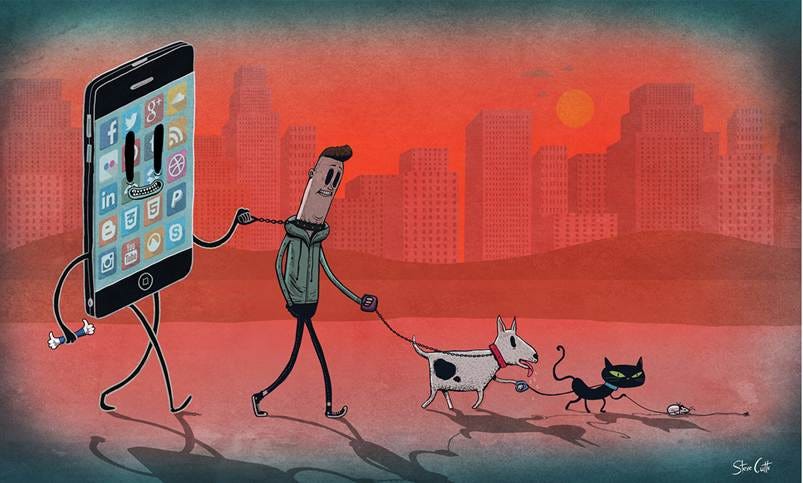
Humans Are Becoming Devices
Reflection on tech vs. culture
Back in the good old days, technology served human culture. Mediums such as VHS tapes, CDs, discmans, radios, televisions and computers enabled us to enjoy, experience, and more deeply engage with culture. Ever since American tech giants made the public web synonymous with social media and algorithmic recommendations, this dynamic flipped; now human culture serves technology.
Canadian media critic Marshall McLuhan couldn’t know how right he was when he said: “The medium is the message”. That statement was about televisions, which we would pay for to watch entertainment on a screen. Nowadays, the screens are watching us back - and the companies don’t pay for it. On social media and streaming services, we are not only consuming entertainment, directly or indirectly we are making entertainment with our data. In a sense, we are entertainment. Not merely the consumers, but the consumed.
The digital transformation of society must be the most defining change of our lifetimes. What it signifies is that we are no longer products of our culture, but products of technology. The tools became our masters. Who would’ve thought? Other technological breakthroughs such as cars, aeroplanes, kitchen appliances and radiators were made to support our journey through life. In contrast, the platform economy is extractive, optimized to consume our finite attention and time on earth, mine our data, and subtly manipulating our minds as a byproduct of commercial aims.
Before the platform business model, youth culture was shaped by communal experiences and great songs such as “Imagine” by John Lennon or “Another Brick in the Wall” by Pink Floyd, which anyone could sing along to. After the platform economy, youth culture is shaped through memes, AI prompts, and TikTok trends at a safe social distance while no one listens to the same queue of songs via autoplay. Technology brings us together, and culture follows downstream from it.
We don’t need to create superintelligent AI models to become a subservient species. We already have our small, rectangular pocket masters. They stare back at us through dark mirrors until we press the side button and the digital universe lights up once more. It’s the destiny for all of us, our children, and their children, to deeply contemplate what this technology signifies, what it has done to us, and what we want from it.
Online culture is obsessed with fast results and the idea of a sudden, monumental change. Viral posts and videos have click-baity titles such as: “This changes everything!”, “Do these five things to improve your life today!”, “AI Is Officially Taking Over!”. As engines of the attention economy, recommender systems prioritize the work of creators who make people click, and psychologically we are drawn to the idea of a sudden monumental change. It could be a personal, positive change - we meet someone special or get a fantastic job offer - or it could be a big, shocking change to the order of the world - aliens are coming. However, from all the loud noise and hysteria on digital platforms, we may have missed a quieter, uneventful, and much more gradual change: humans are no longer at the top of the food chain as we become the devices.
Read more of my thoughts and analysis in “Death To Algorithms: On the entertainment and matchmaking engines that rule our lives”
See my full portfolio of work on Substack for 2025 here