The Creator Economy Is an American Tech Billionaire Scheme
…if not, what is it?
I sometimes wonder if such a thing as “destiny” really exist. Are things just happening at random in life or is there some kind of higher order to it all that we can’t comprehend as humans?
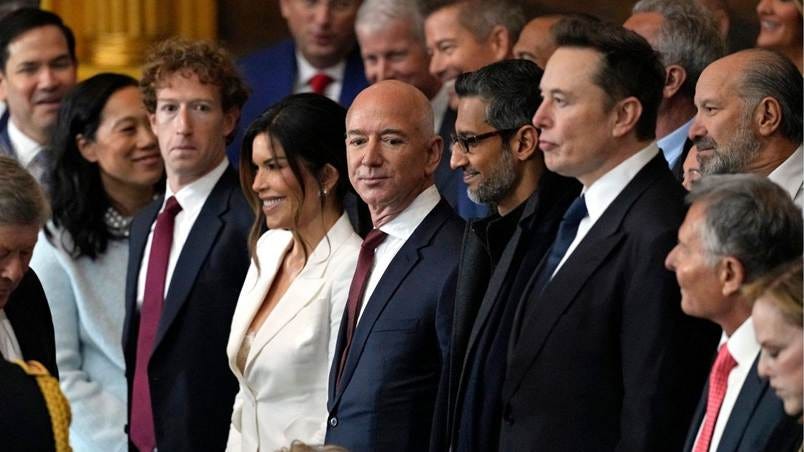
There is a small, but extremely affluent group of people in the US, who strongly believe in the concept of destiny: the billionaire class. The American billionaires tend to believe that they alone can control destiny. Not controlling it in the sense of Invictus (“I am the master of my fate, I am the captain of my soul”) – but controlling it on behalf of all of us, because their brilliant vision and business acumen allow them to see further into the future than ordinary people can. Their beliefs are presumably confirmed to them at any time of day by the sycophantic, human-chair-like personalities that hang around them and those they choose not to unfollow on social media.
I highlight “American” billionaire because people with this type of mindset tend to only be located in the US. The ideas of a near-term AI superintelligence, “the singularity”, the whole TESCREAL bundle – a term coined in a recommended 2024 article by Timnit Gebru and Émile P. Torres – gained enormous traction in Silicon Valley, but not much elsewhere, until recently.
Now the billionaire’s perspective has become immensely important for the US national interest, and so has the bet on artificial superintelligence. You may say that this bet will pay off, I might say it is one of several worrying signs that mark the beginning of the end of US supremacy, but we can disagree on that. What we hopefully can’t disagree on is that our common information ecosystem is broken beyond repair. This happened years ago, long before AI became a thing.
The problem in a nutshell is that major mainstream news media are more than hesitant to report truthfully on issues that may have a financial or political bad outcomes for them. In no small part due to billionaire interests. Independent creators on the other hand, can’t be trusted, frankly, because they tend to lie or twist the truth a lot. On average, independent creators have a laisse-faire relationship with data and citing sources because media algorithms reward strong claims mixed with light fact-checking.
If mainstream media don’t have the courage to report on the truth, and independent creators don’t have the means or the incentives to do it, who will? What is the “creator economy”? From my perspective, it amounts to propaganda, narrative battles, information warfare that plays out on a much larger scale than any individual can comprehend. Let’s not pretend that the social media economy or the “creator economy” works differently. Like people do on LinkedIn.
The social feed on LinkedIn can best be described as a forum for grownups who like to circle-jerk each other all day long by recycling the same topics, the same emojis, the same style of writing, the same prompts and hot takes, while patting each other on the backs, saying they each accomplish something important and unique. As others have put it, LinkedIn is TikTok for people in their forties. It’s a space occupied by people who are no longer comfortable expressing themselves physically, and so they imitate each other through pseudo-intellectual posts instead of silly dance moves. That is unfortunately (for me) the people who wins in the “creator economy”. But do they make any lasting impact or fulfill goals besides catching people’s attention for a minute or two to make people stay longer on the platform?
My point with this note is not to discourage (or encourage) anyone’s creative journey. My point is to say the truth. Which is that life is infinitely more strange and complex than the two-dimensional image of reality that social media paints for us. The American billionaire class and other people who benefit tremendously from the broken information ecosystem want us to forget that. Don’t.


The paradox here is wild: the very platforms amplifying critiques of billionaire control are themselves billionaire-owned infrastrucure. The 'creator economy' basically flips labor risk onto individuals while platforms extract the value, kinda like how Uber did with drivers. I've seen this firsthand with folks chasing algorithmic validation instead of building anything durable or meaningful beyond next week's engagment spike.