

The Right to Freedom of Speech Is Irrelevant on Digital Platforms
It’s all about the control of information. + Spain’s new initiatives against social media , EU’s “soft ban” of TikTok, and Musk’s interpretation of free speech as a personal censorship right.

Not long after the end of World War 2, the UN General Assembly adopted the Universal Declaration of Human Rights (UDHR) - a cornerstone for human rights law interpretation to this day. Article 19 states:
“Everyone has the right to freedom of opinion and expression; this right includes freedom to hold opinions without interference and to seek, receive and impart information and ideas through any media and regardless of frontiers.”
These words sounded noble in 1948 and intuitively made a lot of sense for people in the US, Europe, and in other democratic jurisdictions. In 2026, reasonable and decent people can still nod along in agreement to these words. But our world is radically different now. Chiefly, because of the rapid development and adoption of information technology with social and cultural impacts.
In 1948, the US and the EU were both considered liberal democracies. The US democracy leaned heavily into its free market approach; companies should be able to do business without too much government oversight and bureaucracy. Fast forward to today, and the US can hardly be characterized as a liberal democracy. A transgressive democracy? The EU for its part, was always more of a social-democratic power (reference: Thomas Piketty), emphasizing social welfare, individual rights, and peace over technological innovation and economic growth.
The US and the EU are thus global superpowers with different value sets. Historically, the US was right-leaning, while the EU was left-leaning, but our worldview was more or less the same. Over the last few years, the US has taken a big step to the right, while the EU has arguably slid a few inches to the left. Today, some of the values we once shared are in conflict with each other.
An obvious example is free speech. The average conservative in the US and the average socialist in the EU are both accusing each other of not living up to the principle. Conservatives in the US are furious at hate speech laws in European countries that penalize incitements to violence, threats, holocaust denial, and harassment on social media. The American government is accusing the EU of creating a “global censorship regime” with the Digital Services Act (DSA), a law requiring online platforms to take certain measures to prevent illegal hate speech. Meanwhile, citizens in the EU are following American news in disbelief as innocent people are prosecuted for speaking out against the government or expressing resistance to it.
What does it in fact mean to say that “everyone” has the right to freedom of opinion and expression? The current US administration is evidently not interested in that specific word of the declaration. If the “wrong” opinions spread, it could undermine the government’s agenda, including its violent mass-deportation program and unapologetic self-enrichment schemes.
UDHR was ratified at the time to prevent this exact scenario. Unfortunately, as Trump knows too well, enforcing civil rights is next to impossible if the government refuses to play ball and doesn’t feel obliged to adhere to the ground rules of the Constitution. He is the tyrant George Washington feared.
Given the Trump administration’s contempt for liberal speech rights in its own country, we can safely assume that its accusations against European hate speech laws and the DSA have nothing to do with high-minded free speech concerns, and everything to do with narrative control.
Whether we like it or not, social media platforms, search engines, streaming platforms, certain data-collecting apps, and most certainly AI models, are powerful tools for influencing the public discourse and controlling human beings. In the pre-digital world, no one could foresee just how much power those in charge of our IT systems would have. In hindsight, we were naïve. The EU is now waking up to this reality and trying to correct its past mistakes.
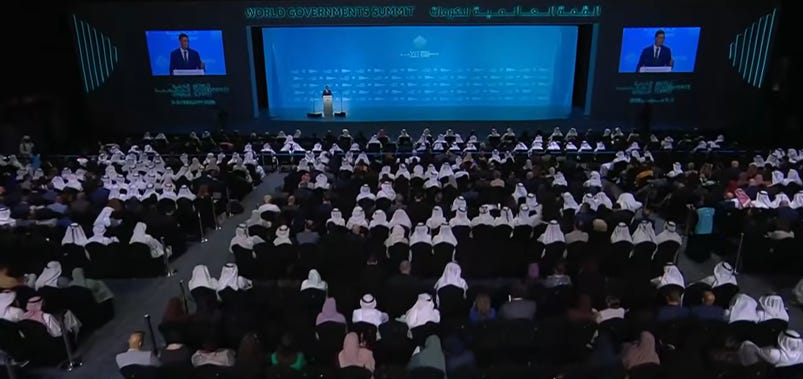
Here is a quote from Spain’s Prime Minister, Pedro Sánchez, recently speaking at the World Governments Summit in Dubai (h/t Jacob Mchangama The Bedrock Principle )
“We were told that social media would become a tool for global understanding and cooperation. A vehicle for freedom, transparency, and accountability. A space where feeds and algorithms would help improve our societies and our lives. But the opposite has happened. Social media has become a failed state. A place where laws are ignored and crime is endured. Where disinformation is worth more than truth and half of users suffer from hate speech. A failed state in which algorithms distort the public conversation and our data and image are commodified and sold.”
Sánchez went on to present five concrete actions the Spanish government will implement this week to reassert democratic control over social media:
1) Change the laws in Spain to hold platform executives legally accountable for failing to remove illegal or hateful content.
2) Turn algorithmic manipulation and amplification of illegal content into a new criminal offense.
3) Implement a footprint system to track, quantify, and expose how digital platforms fuel division and amplify hate and polarization.
4) Ban access to social media for minors under the age of 16 to protect them from “the digital wild west”.
5) Work with the public prosecutor to investigate and pursue the infringements committed by Grok, TikTok and Instagram.
In addition, Sánchez announced that Spain had joined forces with five other European countries in a coalition of the “digitally willing” committed to enforcing stricter, faster, and more effective regulation of social media platforms. The other countries in the coalition are Cyprus, Denmark, France, Greece, and Slovenia which issued a joint policy position in June 2025.
Unsurprisingly, Sánchez’s speech was met with “mixed reviews”. Elon Musk wrote to his 234 million followers on X: “Dirty Sánchez is a tyrant and traitor to the people of Spain 💩”. Telegram CEO Pavel Durov took it a step further by sending the following message directly to all Telegram users in Spain.
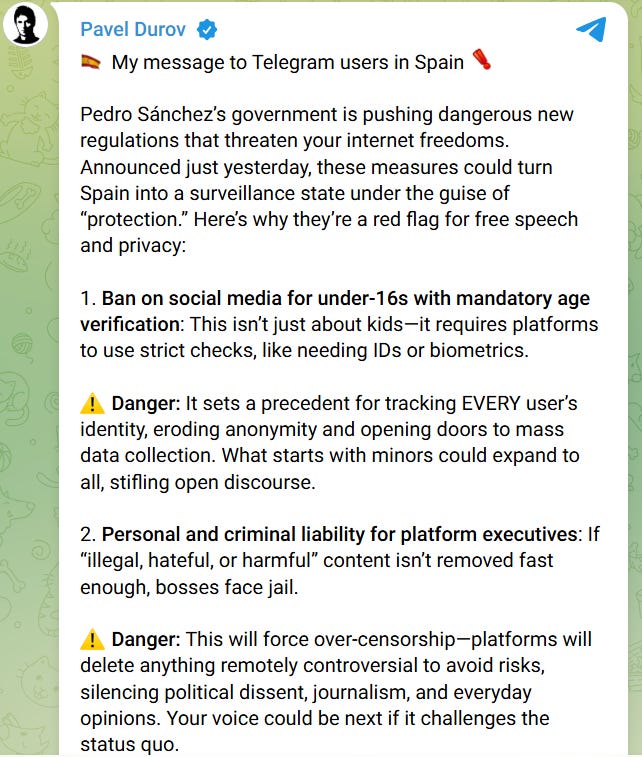
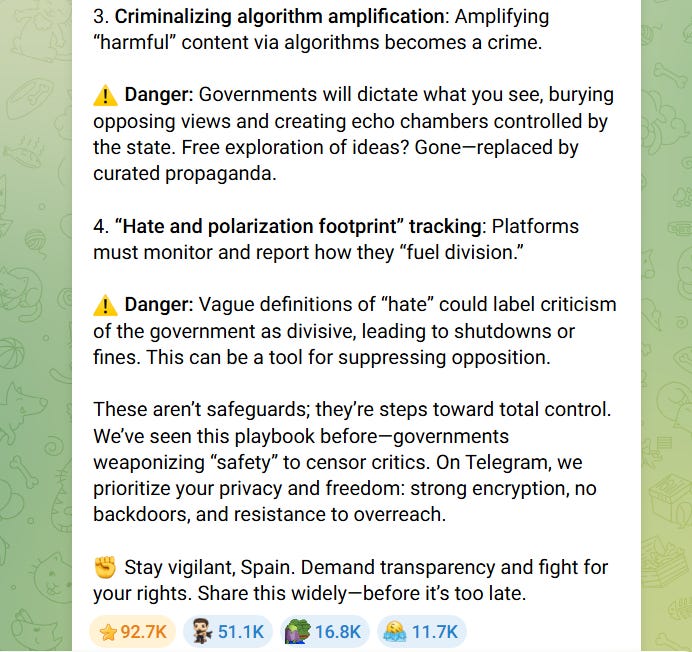
This is a battle of narrative control between governments and tech platforms.
Who is suppressing freedom of speech and privacy? Who is demanding transparency and fighting for human rights? Who do we trust - tech platforms or government?
Ironically, social media platforms like X and Telegram are contributing to creating this environment where geographical borders and local customs disappear as well as barriers between truths and lies, information and misinformation, authentic and synthetic content and data. Undeniably, tech platforms have disrupted the fabric of the state-governed world. Finally, states are pushing back by leveraging the last card they hold: the use of force.
