What if Claude and Chat Are Secretly Working for the Government?


In a previous decade, American social media platforms managed to make surveillance seem “sexy”. Sexyveillance.
Facebook normalized the idea of people sharing everything about their personal lives online as a way of better connecting with others. Nothing should be hidden. Hobbies, personal interests, political views, vacation photos, date of birth, your entire social network, location data, medical history, who you dislike, sexual abuse stories, just put it all out there and don’t hold anything back. It will help you to connect with others. This is the future!
Many people fell for the marketing and followed what their celebrity idols and outgoing friends did without a second-thought. Many people continue to overshare on social media in exchange for clicks and likes. That is because exposing yourself on social media genuinely pays off; such behavior is rewarded by the algorithm. Want to go viral on LinkedIn or TikTok? Post a photo or a video of yourself crying with a caption about some childhood trauma or how hard it is to land a job. Watch your follower count grow.
In 2019, the US government began requiring visa applicants to list their social media usernames/handles from the past five years on the DS-160 (nonimmigration) visa application form. Throughout 2025 and 2026, the requirements have been expanded to more than a dozen visa categories. But linking to your social media accounts in the application form is no longer enough, you have to keep your profiles public for vetting by the US authorities. Oops! Posting that anti-Israel meme may cost you an entrance to the hottest country in the world.
Isn’t it interesting how social media has a dual-use purpose like military technologies? It’s both a fun way to connect with friends and strangers and one of the greatest tools for surveillance ever created. The genius part is you don’t have to follow people around with a camera or continuously ask them questions to know what they are doing or how they are feeling. Users will self-disclose, tell on themselves, because the surveillance seems kinda fun, trendy, and sexy and all the celebrities are doing it.
There isn’t any effective way for laws to deal with voluntary surveillance or “sexyveillance” as I call it. People are free to share what they like online and actions that restrict this right are censorship. The analogy that comes to mind is crypto-investing. Regulators cannot prevent willing buyers from putting their money into memecoins or other pump-and-dump schemes - it’s a free market. Similarly, regulators cannot prevent users from sharing everything about themselves and more on Facebook. Nor can they effectively prevent the companies and the US government from using this data however they please. Sorry, but GDPR won’t save you.
 Tobias Mark Jensen
The Big Tech companies that created the American internet with Facebook, Instagram, Google Maps, the App Store, Amazon, Snapchat, LinkedIn, Twitter, etc. are now building American AI. The leaders are the Big Tech’s proxy companies Anthropic and OpenAI, but Google, SpaceX, and Meta are not far behind. The same money that Big Tech invested in behavior-shaping surveillance tools is now being reinvested in American AI.
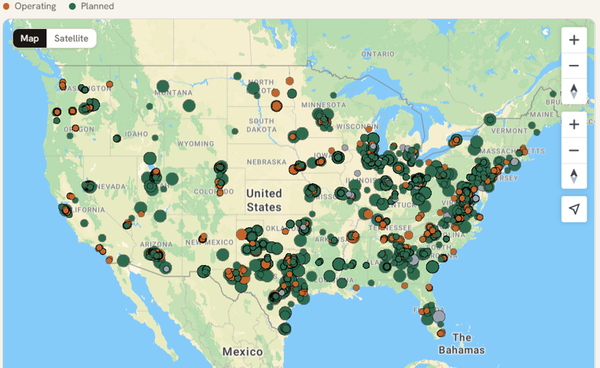
No one understands better than BigTech the value of taking ownership of people’s data and of owning the platform users interact on. That is why Microsoft, Google, Meta and Amazon are expected to collectively spend $1.5 trillion on AI infrastructure across 2026 and 2027, so the successful business model of social media can be extended into the age of AI.
If the American entertainment industry took celebrity worshipping to a whole new level, the American internet gave all people a shot of becoming stars of their own show with the whole world as spectators. Now, American AI removes the need for an audience altogether. You can engage with, talk to, get advice or encouragement from, or receive any information you need directly from the computer. Since it feels like no one is watching, even more privacy-minded people are prone to disclose personal and sensitive information in the intimate room they share with chatbots. But what if Claude and Chat are secretly working for the US government? I will present my case to you below the paywall.
Sexy surveillance was the first great accomplishment of Big Tech. The second great accomplishment is funny fascism.
With Trump back at the helm, the relationship between Big Tech and the government has never been cozier.
BigTech is safe from regulation and politics are entertaining again; a delicious mix of reality show, brutal authoritarianism, and economic nihilism that most people find too irresistible to disengage from. We never know what will happen next in politics, like scrolling a social media feed or playing a slot machine, except the stakes are much higher. What could be more intriguing? It’s a perfect form of entertainment, a twisted kind, but a win-win situation for Trump and those in his cabinet who feed on attention, and for Big Tech companies that profit from people’s screen time and data sharing.
The more American AI struggles financially, the more I think it will be brought home to the government. After all, American AI is a nice to have, not a need to have. If Claude and Chat magically disappeared tomorrow, no one’s life would be that much poorer, compared to the consequences of losing access to the internet, electricity or cars. That is why I think American AI has more potential as a military technology – where it’s used against people – than as a consumer technology – where it’s used as a service to people.
 Tobias Mark Jensen
 Tobias Mark Jensen
No one can know at this stage how closely the government collaborates with its AI companies. But even if the data sharing is limited for now, how long can the government keep its hands out of the cookie jar? So much valuable data is right there for the taking. It would be foolish for a post-democratic government to not interfere and use it.