California Has a Rare Chance To Address the Tech Billionaire Problem


The polls indicate a sweeping blue wave at the midterm elections. In all likelihood, Trump and MAGA will dispute the results. There is also a realistic chance that MAGA will go a lot further than objecting by trying to overturn the election, perhaps through interference by ICE, the military, meddling with voting equipment, or even staging violent riots. In turn, that would probably cause the AI bubble to pop. Such an undemocratic event would shake the bond and equity markets and push interest rates on data center debt higher for an industry that is already under extreme financial pressure. Former US Treasury Secretary Robert E. Rubin lays out the economic consequences of election denialism in the NY Times with a clear-eyed assessment:
“The yield on 10-year Treasuries recently reached 5.36 percent — higher than it was in the aftermath of the 2008 financial crisis — in part because of concerns about the country’s policy trajectory. Election chaos could increase investors’ worry about the ability of our political system to deal with our fiscal problems, driving yields even higher. This would result in higher debt service costs for the government and higher mortgage rates and credit card bills for consumers, exacerbating our already considerable challenges.”
Regardless of what happens, we need to talk about how the US reached a situation where the most central process of a democracy - the free and fair election – is under a credible and acute threat. In this context, many commentators have criticized or made fun of Europe for failing to produce any Big Tech companies. But that is actually a blessing in disguise. Without Big Tech companies, there are no tech billionaires, and these are the primary drivers of democratic backsliding in the US.
Tech billionaires are distinguished from “normal” billionaires by the sheer size of their fortunes. In addition, their political power and influence stems not only from wealth, but from the control they have over public information channels, whether TikTok, X, Facebook, Instagram, LinkedIn, Substack, YouTube, Google, or mainstream media outlets like CNN, the Wall Street Journal, or the Washington Post.
If tech billionaires were good-hearted, selfless philanthropists who eagerly served the society that helped to grow their fortunes, the US would be an affluent country and a desired place to visit for tourists and foreign workers with a thriving democracy. But unfortunately, tech billionaires are selfish and greedy, motivated by self-interest and exponential growth like cancer cells. Under the auspices of Trump II, tech billionaires have managed to reach a special standing in society that currently insulates them from legal and economic consequences related to their actions. That is why illegal monopolies, the source of their wealth, continue to grow larger and more powerful by the year even as consumers increasingly dislike what they offer and regulators try to rein in their power without much luck.
Tech billionairism is the ultimate symptom of how the American dream is turning into the American disease: an extremely individualistic culture where only a fraction of the population has a fair shot at success. But liberalism only works when people are free, i.e. liberated. Tech billionaires are threatening the American prosperity that lasted since the end of WW2, not only because of their wealth, greed and seclusion from democratic accountability mechanisms, but because their detachment from our shared reality leads them to support some deeply stupid and dangerous ideas. Musk alone donated at least $250 million to Trump’s re-election bid in 2024 and joked he would probably end up in prison if the Democrats won. Had the Democrats actually won, it wouldn’t have been a laughing matter for him. But even less of a laughing matter for all of us is the business-friendly and dangerously incompetent Trump administration that is now overseeing the tech billionaires’ quest to replace the world’s intellectual class with proprietary technology, and is already on track to spend trillions of dollars a year.
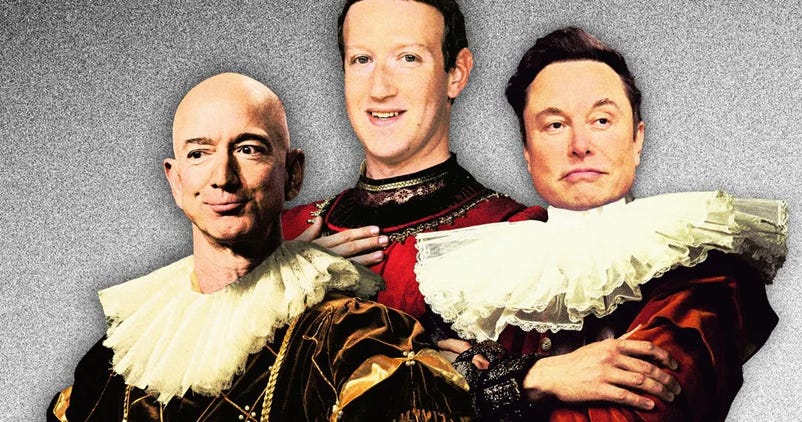
Tech billionaires act like the enemies of the people, but the media industry treat them like royalty and pop culture icons. As a result, many people come to idolize their oppressors, while failing to question why a few individuals can live more lavishly than ancient sultans near areas that look like abysmal movie scenes of a zombie apocalypse. Tens of millions of Americans are struggling to pay for basic necessities such as food, housing, and healthcare, but the media fail to cover that sufficiently, simply because it’s too depressing to read about. On top of that, and beneath that, modern information technology provides voters with an incessant stream of mind-dulling entertainment, that distracts from real problems like spiritual Oxycontin. But dopamine is a poor substitute for literacy. Instead of attacking the platform owners, users attack each other. Voters and media outlets are too busy discussing politics in terms of left and right, blue and red, black and white, East and West, but often fail to address the divide which matters the most, between the very top and the wide bottom.
If only Americans could fight tech billionaires with the same fury that tech billionaires fight taxation. In parallel with the midterm elections, Californians are voting yes or no on Proposition 40, a one-time 5% wealth tax that would be imposed on households with a net worth of more than $1 billion. The tax would be the world’s first wealth tax of its kind and apply retroactively to California residents from January 1, 2026, so billionaires cannot simply evade it by fleeing the state. Of the new tax revenue, 90% would be allocated to healthcare – helping to cover the massive funding cuts California’s Medicaid suffered after Congress enacted the One Big Beautiful Bill last year - and 10% would be allocated to food assistance or education-related programs.
There are many legal and technical concerns about Proposition 40, some minor ones are legit, most are propaganda paid by the tech billionaires’ propaganda machines. Economically speaking, Proposition 40 makes perfect sense. The proposal was supported in a statement by six Nobel Prize-winning economists – Daron Acemoglu, Abhijit Banerjee, Peter Diamond, Esther Duflo, Paul Krugman, and Joseph Stiglitz. Governor Gavin Newsom opposes Proposition 40, but at least recognizes the importance of the issue as he advocates for a national billionaire tax instead.
On the other end of the spectrum, some of California’s best-known billionaires have already left the state in anticipation of the wealth tax, including Peter Thiel and the Google founders, Larry Page and Sergey Brin. Meta has overhauled its ownership structure to shield Mark Zuckerberg, who also threatened to leave, from the tax. Sergey Brin has personally spent $102 million to defeat California’s Proposition 40 and told the NY Times: “I fled socialism with my family in 1979 and know the devastating, oppressive society it created in the Soviet Union (...) I don’t want California to end up in the same place.” Just a charming, community-minded guy, who genuinely cares about the well-being of Californians.
Accelerating in the weeks leading up to Tuesday's ballot vote, tech billionaires have collectively raised more than $340 million to squash the proposed law. Even if the law should pass, representatives of the 250 billionaire residents in California have lobbied to put Proposition 41 and Proposition 42 on the ballot which would nullify the effects of Proposition 40. Proposition 41 is directly targeted at undermining the wealth tax, while Proposition 42 blocks state taxes on personal property , and also prohibits certain retroactive taxes. If either Proposition 41 or 42 gets more votes than Proposition 40, the wealth tax will not come into effect. Finally, even if Proposition 40 gets a majority yes vote, and more votes than Proposition 41 or 42, expect the lawyers of tech billionaires to play every trick in the book, and some from outside the book, to question, undermine, and water down the law.
The US is currently living through a very dark moment. The outcome of the midterms is extremely important, not just for the US, but for the world. Californians have a rare chance to address what I perceive as the root cause of the country’s political issue: tech billionaire wealth. Proposition 40 is not a perfect proposal, but an affirmative vote on it could motivate other proposals in other states and perhaps wealth limiting laws on a national level. That is not socialism or communism, but placing power and resources back to where it belongs in a democratic society, and making up for systemic failures that have been exploited for way too long by nefarious actors.
Read more:
 Tobias Mark Jensen
 Tobias Mark Jensen

 Tobias Mark Jensen