How States Are Responding to the AI Data Center Invasion

“We need to build and maintain vast AI infrastructure and the energy to power it. To do that, we will continue to reject radical climate dogma and bureaucratic red tape, as the Administration has done since Inauguration Day. Simply put, we need to “Build, Baby, Build!”
- From “America’s AI Action Plan
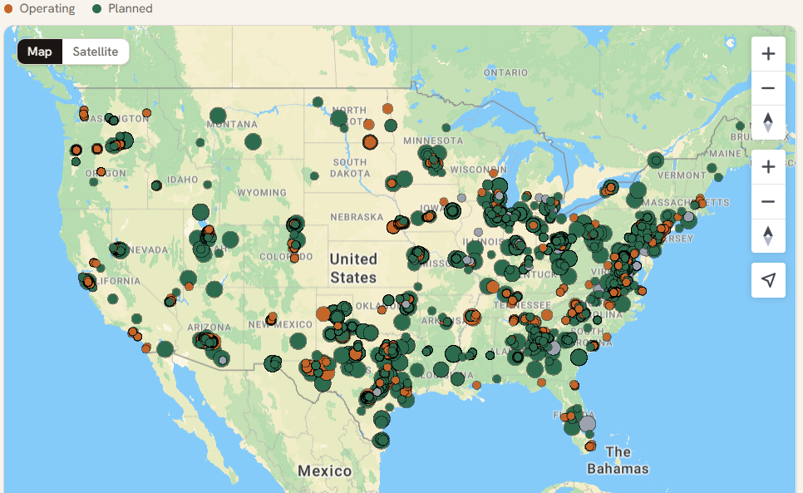
In the earlier days of OpenAI, chief scientist Ilya Sutskever predicted that the surface of earth would be covered in data centers (and solar panels). That statement sounds less far out now than it did three years ago, judging from the map. Indeed, it must be the natural endpoint to the American AI race.
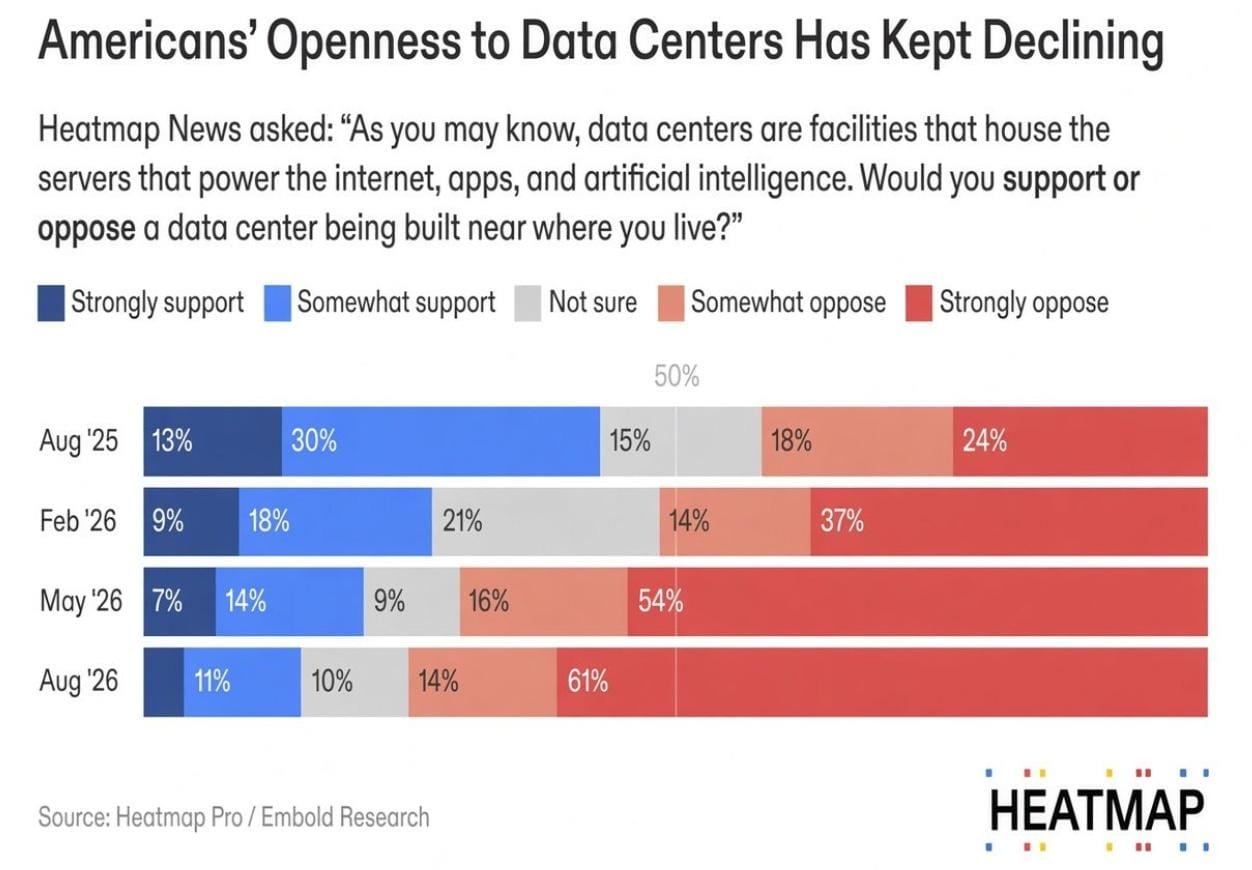
Data centers are the physical infrastructure of AGI, but it has become a hot-button issue that divides state politicians from Trump’s AI agenda. A recent survey shows that 75% of Americans say they would oppose a new data center being built nearby where they live, which makes data centers less popular than the Iran war among voters overall, or even seizing Greenland or Canada by force among Republicans. The negative sentiment towards data centers has taken off over the last year, and it’s not hard to understand why.
Aesthetically, data centers are ugly, huge, noisy buildings that lead to higher electricity prices, consume vast amounts of water and acres of farmland, without contributing that much to local job growth once they are operating. As we shall see, data centers are consuming billions of dollars in state tax revenue, often undisclosed, a wealth transfer from the pockets of fiscally pressured states right into the hands of hyperscalers, Big Tech, and American AI companies.
We can speculate if the opposition to data centers ties into broader concerns about the American AI project as a whole, including fears about how tech billionaires may profit from the technology, while being sheltered from its high economic risks. When the American AI bubble pops, we could see a policy of social welfare for billionaires and austerity measures for the public in a reenactment of the 2007-2009 financial crisis. Furthermore, the American AI project necessarily recreates the internet’s market concentration with a handful of companies owning and controlling everything. There is also the potential - if not the promise - of mass-unemployment, mass-surveillance, environmental damage, new forms of cyberattacks and pandemics, massive copyright infringements, critical errors, and cognitive decline.
On the other hand, data centers are the physical infrastructure for cutting-edge AI models. Without this infrastructure, American AI cannot compete with China, superintelligent life cannot be born – as envisioned by its creators and fans -, and the broligarchy cannot eat up the middle class income that would sustain the boom. It’s hard to be optimistic in either direction. If the American AI project fails, it could spark a new Great Depression. If it succeeds, it could spawn new levels of inequality that make the Gilded Age look like socialism. But Jeffrey Epstein’s best friend remains a firm believer:
“The only reason that communities throughout the U.S.A. should not want Data Centers is if they want to end up being backwards and poor. If they want to be successful and rich, with far lower taxes and jobs all over the place, let Data Reign. The good news is that there are plenty of other places that want them. If we kill the Golden Goose, you will only have yourselves to blame. China could not be happier with this anti Data Center movement. Actually, they can’t believe it is happening! President DJT”
NY Times recently reported that the Environmental Protection Agency (EPA) plans to eliminate federal requirements that states publicize and solicit public input on applications for air pollution permits for data centers, power plants, and other industrial facilities. We are at risk of moving towards a situation where local communities have no say in, and no rights to any knowledge about, whether and how data centers are constructed in their neighborhoods. EPA’s plan is supporting the rapid data center buildout which is needed to carry out the American AI project, but demonstrably defies the will of the public.
Even though the federal government is in a backscratching relationship with Big Tech, state governments are taking responsible measures to protect citizens against the success as well as the implosion of American AI. For example, fifteen politicians running for state office across the country have signed the AI Pact, pledging to ban tax breaks and other giveaways for data center construction, instituting mandatory safety reviews for major new AI models, ensuring worker protection policies, legal accountability for AI companies, and a guarantee to not support any law that would have taxpayers foot the bill for AI companies.
Even more importantly, states all across the US have already adopted serious policy measures to limit or stop the AI data center invasion. Some of these measures are directly disobedient to Trump’s agenda and collectively they may jeopardize the American AI project. The policy measures include data center moratoriums, rolling back tax incentives, prohibiting secret deals and cost shifting, and setting requirements to environmental impacts.
Data Center Moratoriums
On July 14, New York became the first state to impose a moratorium on the construction of new data centers. Specifically, New York is pausing environmental permits of facilities drawing a minimum of 50 megawatts of power for up to one year in order to prepare a regulatory framework “that protects ratepayers, the environment, the energy grid and communities across the state.”
Moratoriums on data centers by law have so far been suggested in fifteen states. As of the time of writing, seven of these proposals have failed and eight are still alive. Maryland and Wisconsin proposed conditional bans on data center construction and operation, respectively, until certain criteria were met – without a specified end date for the pause. Both proposals failed early in the legislative process. The commercial importance of AI for the US economy makes conditional bans on data centers at a state-level - that are not tied to a study period of impacts - unlikely to be adopted.
Maine came very close to adopting a “study pause” on new data centers powered by more than 20 megawatts until November 2027, similar to the moratorium in New York. However, it was vetoed by Governor Janet Mills as it failed to allow for “a specific project” that “enjoyed strong local support from its host community and region.” This means, even though many cities, counties, and towns have enacted local data center moratoriums, the only state-wide ban on data center construction is in New York, and it specifically applies to large “hyperscale” data centers.
However, the Governor of Texas, Greg Abbott, recently ordered a pause on approval of new data center projects going through the state’s grid, citing concerns about rising electricity demands, grid reliability, and power outages. Most likely, the pause is only a speed bump. Forecasts estimate that Texas is on track to become the world’s largest data center hub by 2030, surpassing Virginia. Texas is home to one of the world’s largest data centers, OpenAI’s Stargate data center campus, that was used to train OpenAI’s GPT-6 Astra on more than 100,000 GPUs, marking the company’s largest training run “by far” according to OpenAI’s VP of Research, Aidan Clark.
We should also note that all these data center moratoriums are based on practical concerns about electricity prices, overload of energy grids, environmental impacts, and other measurable effects. The moratoriums tend to not be ideology-based compared to the Artificial Intelligence (AI) Data Center Moratorium Act introduced by Bernie Sanders and Alexandria Ocasio-Cortez in Congress. This bill calls out theoretical concerns about the dangers of AI such as mass-unemployment and other “catastrophic consequences” which are often highlighted by tech CEOs as a way of spreading awareness about their products. Whether or not the catastrophic risks of AI are realistic (so far nothing indicates it), they will likely not translate into laws about data centers. Sadly, corporate interests weigh heavier than safety concerns in general, and the most catastrophic risks for Americans may be that the unprecedented levels of investments in AI do not pay off.
Rolling Back Tax Incentives
The American AI Project is creating a conflict of interest between revenue demands of hyperscalers and fiscal needs of states. As a result, tax breaks, subsidization, special rates for utilities, and other kinds of financial incentives states offered to data centers are now widely rolled back or being reconsidered.
The National Conference of State Legislatures (NCSL) reported in April that at least 38 states offer some form of tax break to data centers (often tied to a minimum investment threshold and job creation requirements). Of these 38 states, at least 28 have weighed legislation that would shrink the benefits. So far, seven states –Nebraska, Washington, North Carolina, Arizona, Oregon, Alabama, and New Jersey – have repealed or limited tax incentives for data centers in 2026. Illinois, Massachusetts, and Ohio have temporarily paused tax incentives through executive orders. Maine is the only state that has repealed all available subsidies. Most of the original tax incentive programs were adopted in prior decades - long before ChatGPT – and they are now costing states billions of dollars in tax revenue a year, often undisclosed.
Virginia - which is the world’s largest data center market by far - enacted a generous tax exemption law in 2010 that applies broadly to compute equipment purchased by larger data centers. At the time of the law’s writing, the state estimated that it would forego roughly $1.5 million per year, but the loss for fiscal year 2025 was nearly $1.94 billion. Virginia preserved the tax exemptions in its budget for 2026, but has added a new electricity consumption tax which charges data center operators $0.011 in tax per kilowatt-hour on electricity consumed with a cap of $600 million per year.
At a low estimate, Texas will lose out on $3.2 billion in sales tax revenue from data centers over the next two years. From 2014 to 2022, the corresponding revenue loss amounted to between $5 million and $30 million per year. After ChatGPT launched and kickstarted the American race towards AGI, hyperscalers and other data center owners and operators saved $150 million in Texan sales tax revenues in 2023, and will save at least $1.3 billion in 2026. The Republican Governor, Greg Abbott, who hailed the oil-rich state as the "epicenter of AI development" less than one year ago, is now calling for a repeal of tax incentives for data center construction.
Kentucky passed a law in 2025 that gave companies a 50-year sales and use tax exemption for data center equipment. One report recently estimated that these tax breaks could cost Kentucky more than $2 billion in tax revenue a year, if just four of its proposed data centers are built. Governor Andy Beshear is now calling to repeal the tax incentives. In a similar vein, New Jersey has taken a u-turn on its tax incentive program for data centers. New legislation known as “End Data Center Tax Credits Act” ends a corporate tax credit program from 2024 that set aside $500 million for AI data center initiatives with nearly unanimous, bipartisan support.
No Secret Deals
Meta secured a deal with Louisiana to build a $50 billion data center named Hyperion in an impoverished farming community. Planners said the Hyperion could cover about six square miles (nearly 2,200 soccer fields) and use seven times as much energy as New Orleans. The New York Times reported how Meta used secrecy and speed to secure the deal and avoid opposition. No public meetings were held about the project, and government officials involved were required to sign NDAs, preventing them from speaking about it to the public.
Under the agreement, Meta shifted significant financial and infrastructure risks away from itself and onto private financiers and Louisiana residents, tax breaks could be worth up to $10 billion, and construction workers needed a place to stay, so rents spiked in the poor surrounding communities leading to families being evicted from their trailer-park homes. In the short term, mega data centers such as Hyperion do lead to increased tax revenue, plenty of jobs for local construction workers, and more valuable property. On the other hand, it’s very concerning how the public is completely sidelined and bulldozed in billion-dollar deals that are made behind closed doors between Big Tech and elected state officials - and may have significant negative impacts on the quality of residents’ lives.
Residents naturally have a vested interest in knowing about planned data center projects in their communities and scrutinizing the terms of the deal. Big Tech companies have an interest in keeping the talks closed and private to quickly secure the deals and avoid unwanted scrutiny. In Wisconsin, a $10 billion data center proposal vanished into thin air after town chair Steven Pate told a real estate company that the proposal would have to be made public.
Measures to either ban NDAs for data center projects or limit what information they can conceal have been proposed by at least 10 states in 2026 — Arizona, Georgia, Maryland, Michigan, Minnesota, New Jersey, New York, Oklahoma, Ohio and Wisconsin. On August 18, 2026, Pennsylvania Governor Josh Shapiro signed Executive Order (EO) 2026-05, Protecting Pennsylvania Consumers from Data Center Impacts, which explicitly forbids NDAs for all state agencies in connection with data center projects.
No Cost Shifting
More than 300 stakeholders in the US power system have committed to a voluntary pledge facilitated by Trump’s White House that promises to prevent ratepayers from footing the bills of data centers. Signatories include Amazon, Google, Meta, Microsoft, OpenAI, Oracle, and xAI. Trump said days before the announcement that data centers had “a PR problem.” But in practice, calculating the energy costs of data centers and how they are allocated is not straightforward, in fact, it’s extremely complicated. Electricity providers are monopolistic like Big Tech and can pass on electricity costs to consumers through secret deals with special negotiated rates for data centers, gaps between state-regulated and federal-regulated transmission costs, and “co-location” arrangements where data centers connect directly to an existing power plant outside of the electricity market, constrain the supply, and drive up prices.
In North Carolina, Duke Energy proposed an 18% rate hike for households to meet the increased energy demands caused by new data centers. An analysis by the Union of Concerned Scientists found that residents across Illinois, Maryland, New Jersey, Ohio, Pennsylvania, Virginia and West Virginia were footing the bill for an additional $4.3 billion in electricity infrastructure projects approved in 2024. PJM, the regional power-grid operator for 13 states, covering parts of the Midwest and Mid-Atlantic, reported that capacity prices rose by more than a factor of ten in two years from $28.92/megawatt-day in most zones for the delivery year of June 1, 2024-May 31, 2025 to $329.17/MW-day in most zones in the delivery year of June 1, 2026-May 31, 2027. Without state regulation, ratepayers may be first in line to foot a substantial part of the bills – despite pledges by hyperscalers to the contrary.
States have taken strong measures to prevent electricity costs from new AI data centers from being onto ratepayers. To highlight just three examples: Virginia State Corporation Commission issued a major ruling in August that requires “large load” data center customers to pay for transmission facilities that are constructed solely to serve them. Governor Ron DeSantis of Florida signed SB 484 which prohibits utilities from passing data center costs onto residential and small business customers and requires large-scale users to pay their full cost of service. The Oregon Public Utility Commission recently approved a new rate structure that ensures “the fast-growing electricity needs of data centers do not contribute to increasing utility bills for Oregon households and small businesses served by investor-owned utilities.”
Environmental Impacts
In parallel with high electricity demands, data centers consume vast gallons of water to cool computing equipment from overheating and generate electricity. One group of scientists has predicted that by 2030, data centers in the US could consume up to 1,125 billion liters annually, corresponding to the entire annual drinking supply of New York City. The global outlook is even more extreme. The UN University Institute for Water, Environment and Health estimates that AI-related water consumption could hit 9.3 trillion liters in 2030, which could cover the annual water needs of over 1.3 billion people in Sub-Saharan Africa.
Several states have now introduced mandatory transparency and reporting requirements on data centers’ water use. In the South-Eastern and South-Western parts of the US, extreme heat and droughts are regular occurrences, which makes the immense water consumption of data centers even more acute. South Carolina has proposed a bill which makes it mandatory for data centers to employ “closed-loop water or liquid cooling system” and prohibits extraction from groundwater or using municipal water for cooling. Kansas ties tax exemptions for data centers to water use restrictions. The Governors of Florida and Arizona have each proposed policies intended to limit the impact of data centers on public water supplies.
Exhaustion of local water supplies is far from the only environmental impact of data centers that states are taking measures against. Proposed bills in Colorado, New Jersey, and Illinois set renewable energy requirements for data centers, particularly “large load” or ”hyperscale” data centers. Massachusetts mandates new, large data centers to cover their energy needs through renewable energy. Virginia and Oregon set minimum requirements for air quality of data center emissions to limit air pollutants. Below the state-level, many local ordinances require studies on noise and light pollution from data centers.
Concluding Thoughts
Based on the research I have done for this piece, state regulation of data centers is based on practical concerns about strained energy grids, overly generous tax incentives, spiking energy prices, and environmental impacts. Hyperscalers and other stakeholders in the American AI race are motivated to build out the physical infrastructure for AGI as quickly as possible, but electricity markets were never designed to accommodate the ferocious energy demands of AI data centers. Over time, it’s not hard to imagine that the states’ rational and object-driven regulation of data centers, backed by public opposition to AI, together with cheap, privacy-friendly and competitive open models from China, and the geopolitical turmoil the US is now engaged in could lead to an economic crisis. If not, well, I am sadly not convinced that an alternative ending to the American AI race would leave humanity better off.