Trumpism & the American AI Project

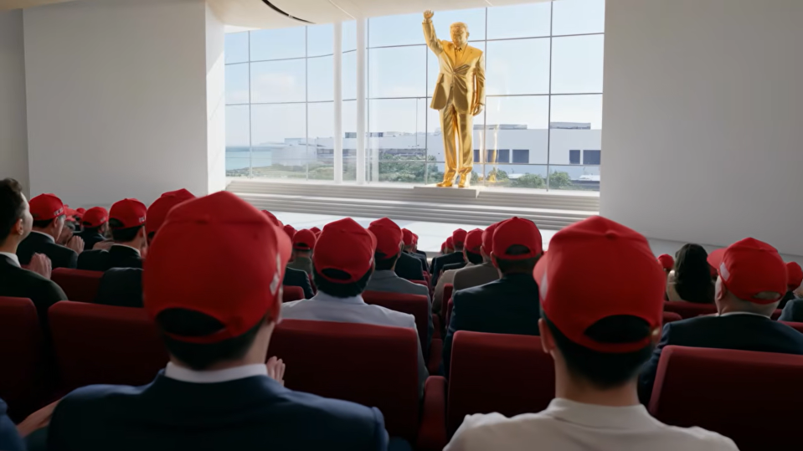
There is an iconic clip from the 2011 White House Correspondents’ Dinner where comedian Seth Meyers jokes about Donald Trump’s ambitions to become President. While the whole room is boiling over with laughter, Trump sits still like a statue with an ice cold stare on his face.
Fifteen years later, it’s clear who in that room was clueless. The political elite was unable at the time to envision in the slightest the seismic shift that was about to take hold of America. Simply, the US population no longer thought that politics represented something real with relevance to their lives. After years of broken promises and a catastrophic war in Iraq that failed, politicians were widely seen as cringe actors participating in theatrical games to humor the population, but voters no longer believed in their empty words and stories.
At the same time, social media had emerged as a new source for public service announcements, replacing the central role of journalism in society. The barrier to be heard was removed with social media. You no longer needed a fancy degree or a sophisticated title to your name before you could get your message across. Every idiot with an internet connection had a chance of being discovered and becoming famous. This was widely celebrated as a win for democracy at the time, especially by the clueless politicians who didn’t understand that their last minutes as leaders of the free world were ticking.
Social media changed the American society in two fundamental ways. First, there was no way to reliably factcheck the abundance of information uploaded every split second, which meant that facts and truthfulness became much less of a factor. What mattered instead was what kind of messaging people were continually exposed to by the algorithms and how it made them feel. Secondly, and this is the important part, power shifted from speakers to those who distributed speech, so from politicians to large corporations. Intuitively, Trump understood all of this, while the political elite who mocked and laughed at him, did not.
As a result, Trumpism won and the established political system in the US lost. Many Americans, and certainly investors, still expect that things will gradually get back to normal after the midterms. But maybe they won’t. I think a more likely scenario is that Kamala Harris, if she is picked to run again for the Democrats, will lose to Trump again in the 2028 presidential election, as Donald is succeeded by one of his children. The old political vanguard remains clueless, in denial, and out of good ideas, failing to grasp what they are up against. Meanwhile, all the negative attention Trump receives makes him stronger, because attention is the new currency in the social media age – good or bad attention, doesn’t matter.
True, Trump is a historically unpopular president for obvious reasons. But it’s also true that each time the American political system has counted Trump out, he has returned stronger with a ferocious appetite for revenge and destruction. Before the 2016 presidential election, Princeton Election Consortium gave Trump less than a 1% chance of winning over Hillary Clinton. In the wake of the 2020 election, the Department of Justice missed its chance to put Trump on trial for his role in January 6, which could have killed his political career indefinitely. Attorney General Merrick Garland didn’t see the urgency, because it seemed clear that the Trump era was over. And by looking at the current polls and feeling confident that politics must return to normal soon, Americans are on track to make the same mistake in 2028, as they did in 2024.
This leads us to the American AI project. AI is arguably more unpopular than Trump. According to a recent Gallup survey, only 9% of Americans believe that AI will do more good than harm. The old political elite in the US is still under the false impression that having power over Big Tech is not the same as having political control over people. Indeed, for now it does seem like US politics and US technology live in two different clusters of reality. For example, while the White House was busy dropping bombs in Iran, Anthropic dropped Fable 5.1 and Mythos 5.1 and OpenAI dropped GPT-6 Astra. The investor class is suspiciously quiet about Iran, but beyond excited about the new models, while most people are concerned about their jobs and role in the future.
Isn’t it fascinating how the country developing the world’s most powerful AI models is also acting out its most barbarian instincts and shamelessly lying about it without concern. In the midst of the special military operation in Iran and threats on traditional allies’ economies and sovereignty, the US economy is remarkably resilient and the stock market continues to explore new heights. We still expect that tomorrow will be like today. But here is a disturbing thought to kick off your week with.
What if the same Big Tech companies that are currently suppressing opposition to and actively providing tools for ICE to catch and detain brown-skinned immigrants could also be used to secure Trump a third term? People aren’t comfortable making this connection, but it’s obviously a risk. The same technology that the investor class is fanboying over could be repurposed to control the population faster than Google and Apple can rename Lake Ontario. Even if it doesn’t play out this way, the potential of this outcome is undeniable. Trumpism and the American AI Project may very well be one and the same.
Next week, we will take a deeper look at the public’s opposition to data centers and the rebelliousness among state regulators, which could be a deciding factor in whether the project succeeds.
Further reading:
 Tobias Mark Jensen
 Tobias Mark Jensen
 Tobias Mark Jensen