Tech Legal Brief #16: Trump Has a Point About the EU Commission’s Big Tech Fines

Welcome to the 16th edition of my newsletter concept Tech Legal Brief. The first edition on Ghost.
Our main story today concerns the geopolitics around the billion-dollar fine the EU Commission recently imposed on Google for breaching its landmark law the Digital Markets Act. Here is what else we will cover below the paywall:
- Another Interesting Ruling Against Google in Europe
- Australia’s Age Restriction Law on Social Media Shows Signs of Success
- A Useful Guide to Digital Privacy
You can find all previous Briefs here.
And one more thing, make sure to look for my introduction post on Ghost in your e-mail spam filter, if you haven’t received it in your inbox – and please mark it as non-spam 😊
Trump Has a Point About the EU Commission’s Big Tech Fines
A week ago, the EU Commission issued its third-ever and largest fine under the Digital Markets Act to Google for self-preferencing on Google Search and anti-steering on Google Play.
Self-preferencing means that Google treated its own services more favorably in search rankings. DMA requires search engines to apply transparent, fair and non-discriminatory conditions to its ranking (Article 6 (5)).
Anti-steering means that Google blocked app developers from communicating and promoting offers outside of Google Play, which app stores are required to allow (Article 5 (4)).
The two instances of non-compliance led to fines of €460 million and €430 million, respectively, €890 million in total. This is a lot of money under any conventional standard, but corresponding to only 0.22% of Google’s revenue from 2025 ($403 billion).
The news of DMA fines to Big Tech companies is usually met with clapping hands and party popper emojis on LinkedIn and self-satisfied celebration posts.
Meanwhile, the American tech companies respond with anger. When Meta and Apple were handed DMA fines last year, Meta’s spokesperson said ”the European Commission is attempting to handicap successful American businesses while allowing Chinese and European companies to operate under different standards". Apple’s spokesperson said “yet another example of the European Commission unfairly targeting Apple”.
 Tobias Mark Jensen
Google’s global affairs president Kent Walker said in an official statement, “to comply, we are having to strip away real-time Search features Europeans love – like instant pricing and direct availability for hotels, flights and restaurants – and dismantle safety protections on Google Play.” To be clear, I don’t think there are Europeans who love these features. We Europeans may love sangria, chocolate, walks in the Alps, late-night dinners, and siestas, but not any specific instant pricing or hotel availability feature by Google.
A more important observation is that Meta, Apple, and Google don’t display sympathy or respect for the EU’s market regulation law. In essence, Big Tech behemoths are not disputing the Commission’s interpretation of the DMA; they are disputing that the DMA exists in the first place.
Apple has so far been the most vocal critic among the tech giants as it's forced to withhold several features from the EU market such as Siri AI for iOS 27 and iPadOS 27 due to the DMA. Apple claims that:
“(..) it’s become clear that the DMA is leading to a worse experience for Apple users in the EU. It’s exposing them to new risks, and disrupting the simple, seamless way their Apple products work together. And as new technologies come out, our European users’ Apple products will only fall further behind.
The DMA also isn’t helping European markets. Instead of competing by innovating, already successful companies are twisting the law to suit their own agendas — to collect more data from EU citizens, or to get Apple’s technology for free.”
I am afraid that anticompetitive behavior is not a design flaw, but a feature of many Big Tech products. The EU Commission sees the abuse of market position as a regulatory issue, but honestly, the maintenance of digital monopolies in the US is necessary to build American AI and keep the country’s economy afloat.
AI-related stocks constitute up to 45% of the S&P 500 Index. Four hyperscalers – Microsoft, Google, Meta and Amazon – will spend roughly $725 billion (!) on AI infrastructure in 2026 alone. Without locking down the digital industry in all democratic countries, how can these capital expenditures possibly be justified?
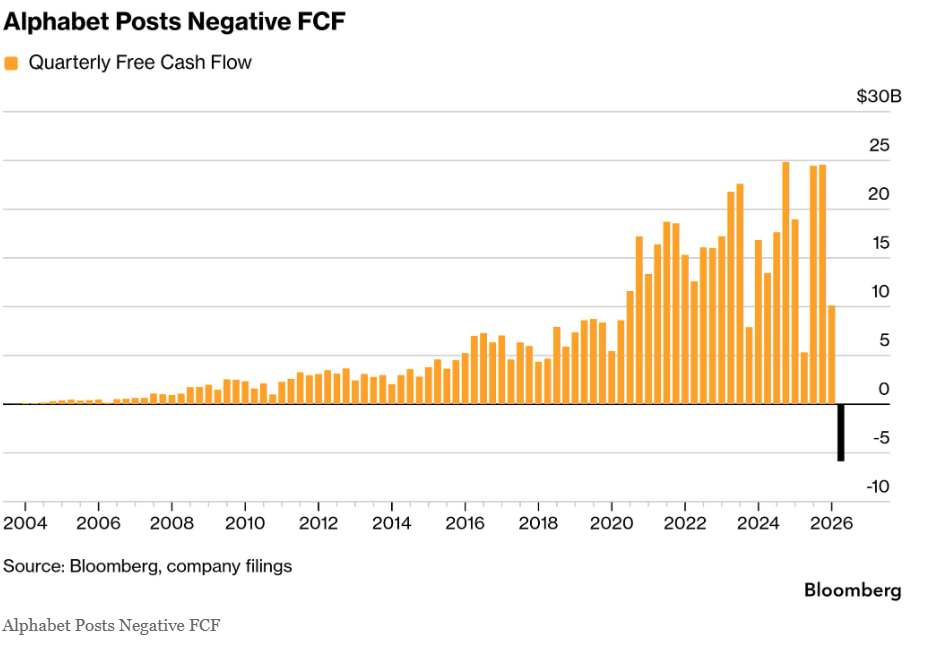
Due to the ballooning spending on AI infrastructure, Alphabet/Google reported a negative free cash flow for the first time ever in Q2 2026. It looks pretty remarkable on this graph by Bloomberg.
The central economic importance of Big Tech and the sensitivity of the American “AI bet”, turn any restraining action by the EU into a perceived political attack. This is where things get interesting.