Von Der Leyen’s State of the Union Speech 2026 & the Broader Environmental Impacts of Data Centers


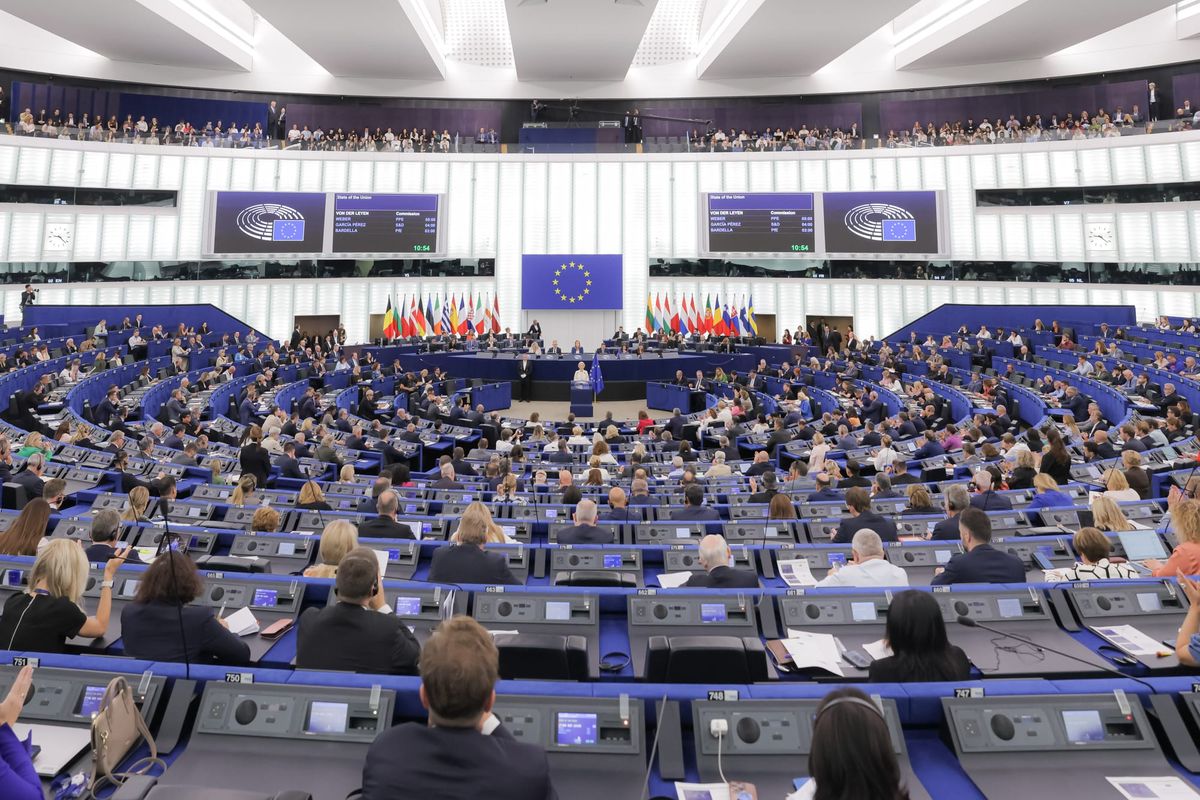
Ursula Von Der Leyen said in her State of the Union speech to the EU parliament last Wednesday that Europe’s future prosperity and security will greatly depend on how it manages two tipping points: climate change and AI.
Ambitions on the latter seemed notably tempered compared to last year’s announcements. In February, 2025, at the AI Action Summit in Paris, von der Leyen said she envisioned Europe as an “AI continent” competing head-to-head with the likes of US and China in the “AI race”. At the same event, von der Leyen announced the launch of InvestAI, a public-private investment partnership aiming to mobilize €200 billion into European AI infrastructure, namely the construction of nineteen interconnected data centers known as “AI factories”, built to train large foundation models. The largest of these AI factories would be designated “AI Giga Factories” inspired by the success of CERN - the world’s largest particle accelerator hosted in a laboratory in Geneva.
In this year’s State of the Union speech, von der Leyen’s framing of AI was more measured, shifting from an open race the EU could participate in and win on its own merits to a “tipping point” which climate science defines as: “a critical threshold beyond which a system reorganizes, often abruptly and/or irreversibly.” Notably, the term “tipping point” somewhat coincides with Silicon Valley’s concept of “singularity”, a hypothetical future point in which superintelligent AI advances so quickly and autonomously that it escapes human control and becomes ungovernable. Both terms imply an irreversible and unmanageable paradigm-shift. Von der Leyen subtly admits that the EU is as much in control of AI as it is of climate change: not at all.
The slight resemblance between the concepts of “tipping point” and “singularity” was far from the only inspiration von der Leyen drew from Silicon Valley’s vocabulary. Von der Leyen mentioned that “models being developed will allow hacking on a level we never thought possible,” “the dangers of self-improving models,” that “incidents of AI agents escaping their environment or inserting malicious code are a mere glimpse,” and finally, invites frontier labs for a discussion on “ how we can support ongoing industry efforts to pace the frontier” (the title of Anthropic CEO Dario Amodei’s recent essay).
Look, I understand why people are worried and we shouldn’t discount the catastrophic risks of AI completely. At the same time, American foundation models, for all the incredible investment in them and attention around them, have not yet – as far as I am aware – done anything a trained human in their field is unable to do. The models are not “superintelligent” or “recursively self-improving” in the sense Silicon Valley salespeople want us to believe.
Even if “superintelligence” or “AGI” was possible in the near-term, there are immense physical and financial barriers preventing current progress from scaling much further. That may also be part of the reason why prominent CEOs of AI companies are calling for a “pacing of the frontier” - it will win them time to harvest more resources to carry out even more expensive training runs.
There are good reasons to treat statements by American AI labs and media headlines with a great deal of skepticism and caution. Veteran AI researcher Ben Goertzel lays out well here, how the explosive virality of the recent whistleblower-like account from an Anthropic employee who resigned because “the people building AI earnestly believe that it could kill us all by the end of the decade” seemed like a coordinated media campaign spearheaded by the Effective Altruism movement.
The EU Commission seems to compromise on its vague goal of competing with the US and China in the “AI race”. Von der Leyen said in her speech: “we do not need to be the ones who develop the frontier technology to be the ones who draw the greatest value from it”. Instead, the EU aims to put guardrails in place with the AI Act and through collaborations with like-minded middle powers such as Canada and the UK on matters such as model evaluation, verification, early warning, and security.
To quote Marine Le Pen’s protégé, Jordan Bardella, in the State of Union debate: “we regulate what we no longer know how to manufacture, and we import what we have ourselves forbidden to produce (..) let us finally embrace European preference in public procurement”. No matter what our political views are, it would be foolish to not take this criticism to heart.
In regards to AI and the digital market more broadly, Europe finds itself in a precarious position. It cannot yet stand on its own feet, but it cannot continue to rely on Big Tech either as the companies are untrustworthy and subject to Trumpian whims. For the time being, developing and fine-tuning open-weights models seem like the best and only option for Europe to work on industrial applications of AI, while also retaining data sovereignty.
Von der Leyen recognizes that Europe needs its own AI capabilities too, in particular to protect national security and achieve independence. According to von der Leyen, this requires that the EU massively boosts its computing capacity. Aligned herewith, the EU’s Cloud and AI Development Act states that the EU should triple its data center capacity within the next 5-7 years. However, this “tripling of data centers” appears without any specification or scientific underpinning in breach of the Commission’s own guidelines for regulation.
I was curious to learn more about whether the EU can align its ambitious sustainability and clean energy goals with its planned, rapid expansion of data centers. I therefore asked Aysu Kececi, who is an environmental consultant, and previous contributor to Futuristic Lawyer to look at the environmental impacts of data centers. Here is what she has to say.
The Broader Environmental Aspects of Data Centers
Beyond electricity, water and carbon emissions, what should we actually be accounting for?
Data centers have become one of the defining pieces of infrastructure of the AI era. Alongside their rapid expansion, an increasingly fragmented environmental debate has emerged around them. How much electricity do they really consume? How much water do they use? And how large could their carbon footprint become?
These are important questions, and I will touch on electricity, water and emissions here too. But on their own, I don't think they give us the full picture. This time I want to look at both the intersection of data centers and environmental impact, and at how we should approach this from a more systemic perspective, including the parameters that stay invisible. If you'd like to look further, I examined the energy and water footprint of data centers more closely in an earlier piece, where I also talked about some of the possible innovative solutions and restrictions.
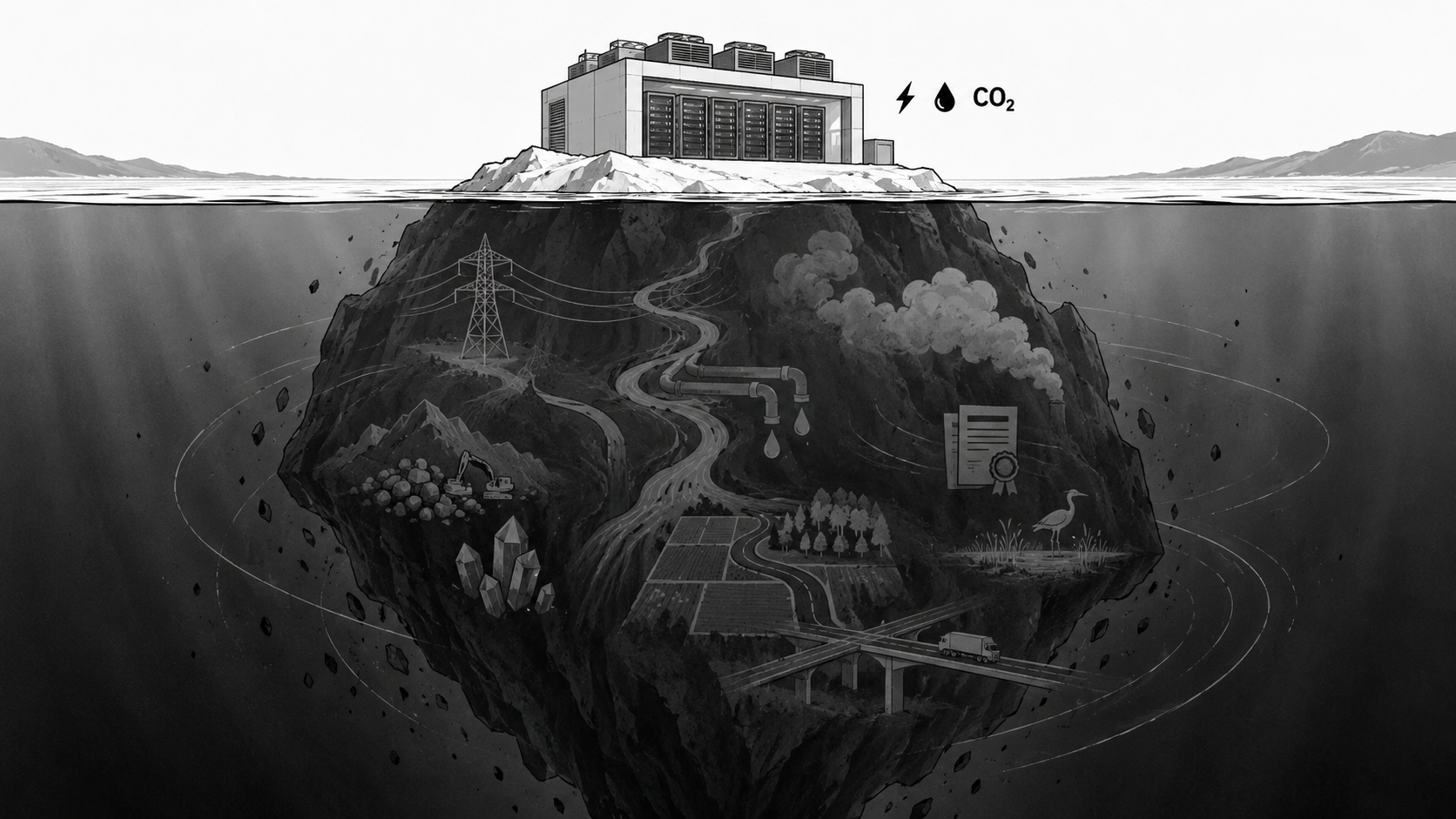
The more I have looked into the environmental impact of data centers, the clearer it has become that some of their most consequential effects do not necessarily stay within their walls. A data center can be extremely efficient on paper and still create pressure far beyond the facility itself. And many of those consequences are decided before the first server is even switched on. That is the part below the surface that interests me here.
It matters particularly now because AI is bringing unusually large amounts of electricity demand into particular regions, and it is bringing that demand quickly. Energy systems, on the other hand, are not usually built quickly. Grids, generation capacity and transmission infrastructure can take years to plan, permit and connect.
That mismatch creates pressure to find whatever can deliver power fast enough. Sometimes that means expanding existing infrastructure. Sometimes it means building new generation. But it can also create enough commercial pressure to push technologies and solutions that previously struggled to reach scale. This has left me returning to the same question:
A renaissance in sustainable solutions, or a lifeline for fossil fuels?
There is something unusual about this wave of energy demand. Previous waves of clean-energy development often needed demand to be created around them. Regulation pushed them forward, subsidies helped make them competitive, and governments set targets to create markets. This time, the customer is already waiting.
Data centers need enormous volumes of reliable power, often on a much shorter timeline than the infrastructure required to provide it. That creates something potentially very valuable for emerging technologies: an urgent buyer. But those buyers are not necessarily asking for clean electricity. First and foremost, they are asking for power they can count on, and that leaves the outcome genuinely open.
The same demand could help bring geothermal, advanced nuclear, long-duration storage and new grid technologies to commercial scale. It could also push innovation on the demand side itself, from more efficient cooling and computing architectures to radically different ideas such as DNA data storage, which could one day change the physical resources needed to store enormous amounts of information. Or, if cleaner solutions cannot be permitted, financed and connected quickly enough, urgency could favour another generation of gas infrastructure that remains in operation for decades. In reality, we are already seeing signs of both.
The footprint today
Before looking beyond the footprint, it is worth putting its current scale into perspective, starting with the part that is easiest to measure.
Electricity is the most visible part of it. Global data-center electricity consumption reached around 485 TWh in 2025, after growing 17% in a single year. The IEA expects that figure to roughly double to 950 TWh by 2030, equivalent to around 3% of global electricity demand. Electricity consumption from AI-focused data centers is expected to triple over the same period. Three percent is significant, but it is not, by itself, an energy crisis. The more interesting issue is how unevenly that demand lands: in the United States, for example, data centers are expected to account for almost half of electricity-demand growth through 2030.
Water is a harder number to pin down than electricity. Data centers can use water directly for cooling, while their wider footprint may also include water associated with electricity generation and even semiconductor manufacturing. As I will come back to later, the answer changes dramatically depending on where we draw the boundary.
Carbon, by contrast, follows the electricity story closely. Data centers currently account for around 180 million tonnes of indirect CO₂ emissions from electricity consumption, roughly 0.5% of global fuel-combustion emissions. That remains a relatively small share globally, but it is growing, and the impact of any individual facility depends heavily on the electricity system behind it.
Taken together, these numbers tell us that the footprint is growing. But they still tell us surprisingly little about the system being built to support it.
The problem is not only how much, but where and how fast
Electricity systems do not experience demand as a global percentage. They experience it locally. A large data center can bring hundreds of megawatts of new demand to a single grid, while some of the largest campuses being planned reach into the gigawatts.
The other part of the problem is speed. A new data center can take roughly one to three years to build. Major new grid infrastructure can take five to fifteen. The IEA estimates that grid constraints could delay around 20% of the global data-center capacity planned through 2030, which makes my original question more interesting.
A renaissance, a lifeline, or both?
In the United States, natural gas currently provides more than 40% of the electricity consumed by data centers. Through 2030, the IEA expects gas to provide more than 130 TWh of additional annual supply, with renewables close behind at around 110 TWh. So, at least for now, both futures are emerging at the same time.
AI demand is not inherently clean or fossil. It is a very large and very urgent customer. The environmental outcome depends partly on which technologies can respond to that customer in time. If cleaner generation, storage and transmission cannot be permitted, financed and connected on the buyer's timeline, urgency can favour whatever is available first. But if geothermal, nuclear, storage and other clean firm technologies can compete on that same timeline, these customers could become unusually powerful forces for bringing them to scale.
Microsoft's deal with Constellation Energy is a strong sign that preferences could shift toward clean energy. In 2024, the two companies signed a 20-year power purchase agreement to restart Reactor 1 at Three Mile Island. The reactor had been shut down since 2019 for economic reasons and sitting idle. The famous partial meltdown in 1979 happened at the neighbouring Reactor 2. What makes the deal valuable is that a plant nobody wanted five years ago can now produce at meaningful scale and contribute to Microsoft's carbon-negative target. It also seems that nuclear energy, long seen as too risky or too politically costly to expand, may be finding its way back as a source companies trust for large volumes of clean, reliable electricity.
There's another example about clean electricity that I find interesting. Project Bison in Wyoming was meant to become a direct-air-capture facility aiming to remove millions of tonnes of CO₂ from the atmosphere. But it couldn't secure the electricity it needed, losing out in the competition to data centers and crypto miners.
So a carbon-removal facility lost the race for clean electricity to industries that produce emissions. Which means a facility that looks clean on paper can have a background just like this.
Water shows why the boundary matters
Water makes it even clearer why defining a data center's environmental footprint is hard. Two terms that look interchangeable actually measure very different things. Water withdrawal is the total amount taken from a source, while water consumption is the portion that doesn't return to the same basin, usually because it evaporates.
One estimate suggests global AI demand could account for 4.2 to 6.6 billion cubic metres of water withdrawal in 2027, while consumption under the same framework is estimated at only 0.38 to 0.60 billion cubic metres. Same infrastructure, but a very different number depending on what we're measuring.
We can widen the boundary even further. Do we only count the water used to directly cool a data center, or also the water used to generate the electricity it consumes? China offers a striking example here. One narrower estimate put data centers' annual water consumption at around 1.3 billion cubic metres. A later facility-level study that included both direct and indirect water footprints reached an estimate of 15.7 billion cubic metres for 2022. This difference doesn't necessarily mean one number is wrong. The studies are just drawing the boundary around the data center in different places.
Cooling, carbon accounting, water stress
Cooling also ties the electricity and water parameters together. In less efficient facilities, cooling can account for more than 30% of total electricity use, while in efficient hyperscale designs that share can drop to around 7%. So the decisions made to remove heat, and the innovative solutions used for it, can shift both the electricity and water footprint at the same time.
This is exactly the part reporting needs to pay attention to. While big companies, FAANG among them, are staying more reluctant to publish footprint figures for their data center and AI work, what we actually track and what we want to see in these reports really matters.
Water also shows something carbon accounting can easily miss: location matters enormously. A cubic metre of water used in a water-secure region doesn't have the same impact as the same amount consumed in a basin already facing serious water stress. A 2025 study of Chinese data centers found that 72% of computing capacity was located in severely water-scarce regions.
Reducing water use is therefore only part of the solution. Where we build can matter almost as much as how efficiently we build.
Why data center locations matter
First, and this is something everyone already knows: data centers love naturally cool regions.
The Nordic countries are one of the clearest examples of this. Cooler climates let operators use outside air for "free cooling" for much of the year, which cuts the energy needed to remove heat. Microsoft's data center region in Sweden and Google's newly announced €13 billion expansion in Finland both use this approach. It lowers both emissions and bills. Another example is Google's existing Hamina campus. The facility uses seawater from the Gulf of Finland for cooling, and is expected to cover around 80% of the local district heating demand. Vienna is an example of doing this too, even without a cold climate. Since 2023, waste heat from roughly 120,000 servers at a Digital Realty data center has been redirected to the neighbouring Klinik Floridsdorf.
So the environmental impact of data centers can vary significantly based on location too. The most extreme example of this is Starmind, SpaceX's planned AI satellite megaconstellation, which would move data centers into orbit and give them constant solar power independent from Earth's grid, beaming the results back down through Starlink. It's a good example of just how far out of the box we can think about location choice.
Where the rules currently stand
At the intersection of data centers and the environment, I just want to briefly touch on a few important rules to show where things currently stand.
The biggest attempt at this so far is the EU's Energy Efficiency Directive. First introduced in 2012 and significantly revised in 2023, it requires every data center above 500 kW to report its energy and water efficiency, PUE and WUE, annually to a shared EU database. The first national deadlines only landed this year, Sweden's on 15 May 2026, so the rule is still barely out of its infancy.
What stands out right now is that two regions are moving in opposite directions at the same time. Spain has drafted a rule requiring new data centers to source 80% of their power from newly built renewables, putting additionality directly into law. The United States has gone the other way: a 2026 executive order streamlined environmental review and permitting for data centers, and in June 2026 the EPA handed most of the responsibility for regulating AI data centers over to states and local governments.
Data centers and physical limits: what countries are saying
Europe is already showing the rest of the world what can happen when data center growth starts hitting physical limits.
Amsterdam and neighbouring Haarlemmermeer temporarily halted new data center projects in 2019, after rapid growth began putting pressure on electricity infrastructure and scarce urban land. This lines up with Amsterdam's existing ambition to become a carbon-neutral city, and the pause is now being used to bring in stricter policies.
Ireland is a striking example of concentration. Data centers accounted for 23% of total metered electricity consumption in 2025, up from just 5% a decade earlier.
Ireland had placed a moratorium on new data centers connecting to the grid around Dublin, and lifted it in December 2025. It has now attached new conditions instead. Under a policy published by the Commission for Regulation of Utilities, any data center seeking a grid connection must install on-site generation or battery systems capable of covering its full electricity demand. Operators will also be required to feed power back into the national grid when needed.
But restricting growth in one place, or only some countries acting responsibly and bringing in new rules, does not eliminate or delay the demand. It can push data centers toward regions with fewer rules, grids that cause more carbon emissions, or scarcer water, and can turn a local gain into a global loss. So this is another insight worth keeping in mind.
But the trajectory could still change
Most current forecasts assume that AI development, and the infrastructure required to support it, will continue expanding rapidly. I think that is probably the most likely direction. But it is not the only possible one.
Just this week, Anthropic CEO Dario Amodei argued that the pace of AI development should be deliberately controlled and slowed down, so that safety research and governance mechanisms can keep up. This argument wasn't about energy or data centers, but any development related to AI directly affects data centers too. If AI development slows down, even temporarily, the timeline of the infrastructure built around it could change, or our chances of seeing the right new laws could increase.
The amount and type of infrastructure we'll need could also change because of the technology itself. DNA data storage is a good example of this. Of course, it's still far from replacing conventional data storage at scale, because of major challenges like cost, writing speed and data retrieval. But it's an important example that reminds us today's physical data storage architecture isn't permanent. Quantum computing and neuromorphic computing are examples of technologies on the horizon, and the efficiency they could offer might also shift how much of any given resource we'll actually need.
The same applies to efficiency improvements, new cooling architectures, flexible computing, new forms of energy storage and, at the more speculative edge, orbital computing.
None of these possibilities is a reason to dismiss the infrastructure being planned today. Gas plants, transmission lines and data centers are being built now, and many of those decisions will stay with us for decades. But today's forecasts are not descriptions of a future that has already been written.
So, renaissance or lifeline?
We may be living through one of the most interesting periods in human history, one where many systems we've long accepted without question are changing at the same time. AI has created enormous demand for reliable, stable electricity, and while fossil energy sources we once counted on as always reliable are running into obstacles like wars, political rivalry and supply disruptions, sustainable energy sources like solar have proven themselves.
It's a fact that in the short term natural gas will keep meeting a large share of demand, and will stay locked into systems already built around it, but I don't think the path to meeting new energy demand will run primarily through natural gas forever. Renewable energy is now seen not only as a decarbonization tool but also, especially for countries trying to reduce their dependence on imported fuels, as a matter of energy security. At the same time, innovative solutions, energy storage, geothermal, advanced nuclear technologies and grid technologies are developing rapidly, with the world's technology leaders watching closely, and they will keep developing in ways tied to AI that we might not even be able to imagine yet. There are also customers with enormous demand for reliable energy who are ready to spend large amounts of money to secure it.
My bet is that this pressure will push us to use alternatives faster, to scale technologies that previously struggled to find a big enough market, and to speed up the adoption of solutions that would otherwise have taken us much longer to build.
We are also making all of these decisions in the middle of geopolitical instability, rapidly changing technology and, frankly, a certain amount of madness.
So I remain a skeptical optimist. I don't think we know the answer yet. We are going to find out together.